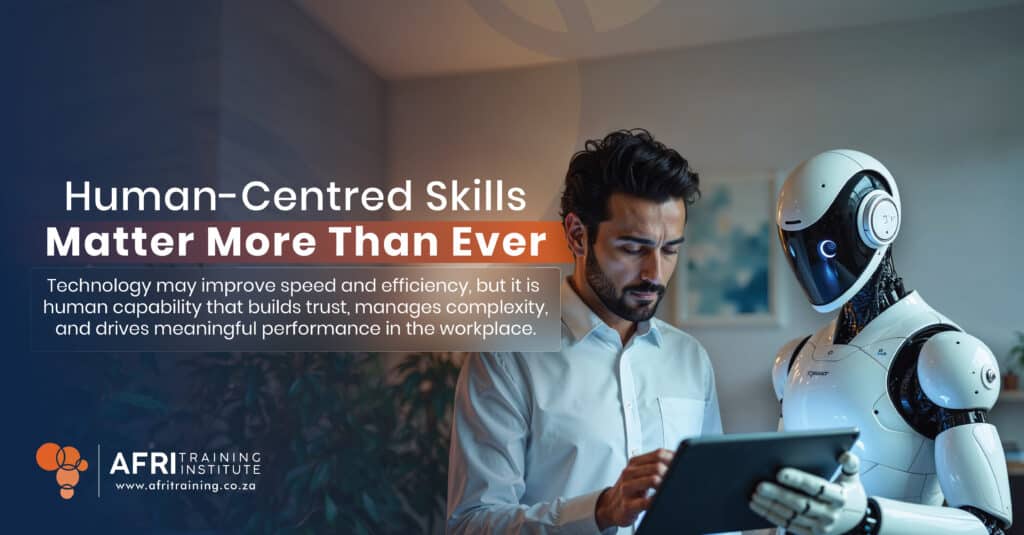
Artificial Intelligence (AI) is already part of everyday business life. It drafts policies, summarises reports, generates research, and helps teams to work faster. At Afri Training Institute (ATI), we see it in our own operations. Our material developers use AI tools as a starting point for research, and our quality assurance team may use it to create a base for policies before refining them. It helps us stay current. It saves time.
Used correctly, AI is a powerful support tool.
But the moments that define performance in an organisation are rarely routine. They are the uncomfortable, ambiguous, very real human moments. For instance, a tense customer call, a disagreement between colleagues, or a hiring decision that looks right on paper but does not quite work in practice.
In those moments, human capability becomes the differentiator in business, not technology.
Understanding AI in business
AI delivers clear benefits to organisations operating in a resource-constrained environment such as South Africa. It can automate repetitive tasks, assist with data analysis, improve forecasting, and streamline administrative processes. It gives teams back time. It helps people focus on higher-value work.
What it does not do is understand context the way a human being does.
AI cannot fully grasp cultural nuance, lived experience, or the emotional weight behind a situation. It cannot read the room during a difficult conversation. It cannot detect when a team member is quietly disengaging. It cannot carry responsibility in the moral sense. AI responds to patterns and does not experience consequences.
One of the clearest lessons in empathy I have seen came from a disciplinary conversation. A team member who was consistently late eventually asked her manager to join her one morning to see what she went through before arriving at work. That experience shifted understanding. It moved the issue from policy to perspective. No algorithm could have delivered that insight.
Empathy grows through exposure and reflection. It is practised. It is felt.
From “soft skills” to power skills
Terms such as emotional intelligence, empathy, critical thinking, and decision-making are increasingly referred to today as “power skills”. These capabilities are essential in a modern business landscape. They determine whether technology is applied wisely and whether teams function effectively.
Emotional intelligence helps people navigate conflict and uncertainty. Critical thinking prevents blind reliance on tools and encourages questioning. Sound judgement ensures that decisions consider impact, not only efficiency. Adaptability allows teams to respond when circumstances shift unexpectedly.
In a diverse country like South Africa, where workplaces reflect different languages, histories, and lived realities, these human capabilities are integral to daily operations.
Technical competence may get someone hired, but behaviour determines whether they can thrive.
Can empathy and intuition be developed?
Many leaders ask whether skills such as empathy or intuition can be taught. They cannot be downloaded. But they can certainly be strengthened.
Intuition is often pattern recognition built over time. It improves with exposure, feedback, and experience. Empathy develops when people are encouraged to step outside their own frame of reference and engage meaningfully with others.
In our experience, behavioural capability shifts when people are given opportunities to practise. It is not enough to attend a two-day course. Real change happens through coaching, ongoing conversations, reflective practice, and structured opportunities to apply new approaches.
We currently work with clients on year-long retainer models, with monthly “power sessions” focused on topics such as critical thinking, leadership mindset, and managing difficult conversations. This consistency matters because behaviour shifts through repetition.
Leadership in an AI-saturated world
As AI adoption increases, leadership itself is evolving. Hierarchy alone no longer drives performance. The leader of the future must be a coach.
Coaching does not mean abandoning standards. It means creating environments where people can think independently, question respectfully, and learn from mistakes without fear. It means recognising that behaviour shapes culture, and culture shapes results.
When the next disruption comes, organisations with strong human-centric capabilities respond differently. When disruption hits, organisations with strong human capability respond differently. Their communication is clearer, and problems are addressed collectively, with teams able to adjust.
AI will continue to evolve. It will become more integrated into systems and workflows. It will help us process information faster than ever before.
But it will not replace the human factor.
The organisations that gain real competitive advantage will be those that combine technological advancement with deliberate investment in emotional intelligence, ethical judgement, critical thinking, and coaching-led leadership.
At Afri Training Institute, we support businesses in strengthening these human-centric capabilities through applied learning models, coaching frameworks, and structured development strategies that align with the realities of South African workplaces. Technology may be the enabler, but people will always remain the differentiator.
WhatsApp us
